
Claude Code writes the change
Diversion keeps the context
The Diversion plugin guides Claude Code to work with dv, connects every commit to the conversation that produced it, and lets developers or agents ask why the code changed.
Ask what changed
Understand why
Developers and agents can use Diversion Ask to retrieve the conversation, commit history, and code context behind a change before making the next one.
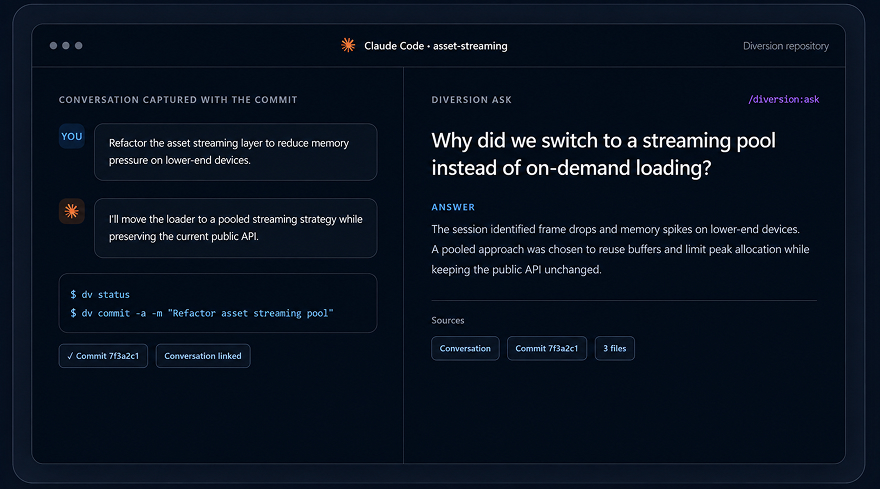
One plugin context that stays with the code
Claude Code works directly with Diversion, while the plugin preserves the conversation behind each commit and makes it available through Diversion Ask.

Claude Code plugin
- Single distribution unit — install once
- Lives where your engineers already work
- No new dashboards, no new tools to learn

Context for people and agents
- Claude can retrieve context before changing existing code
- Agents understand previous decisions and constraints
- Developers do not have to reconstruct intent from the diff alone

Reasoning storage
- Plugin hook captures every reasoning turn
- Linked directly to the commit it produced
- Stored alongside your repo, indexed in real time

Trajectory Query
- Ask questions in natural language
- Answers grounded in the actual session turns
- Available from your agent, CLI, or web UI
Tribal knowledge, now a query away.
Diversion answers from the actual sessions that produced your code — not from documentation that's stale, or guesses based on the diff.

Stop reverse-engineering. Start asking.
When something breaks at 2 AM, ask Diversion what the function was meant to handle and what edge cases the agent considered — straight from the session that wrote it.
What was the previous fix?

Every architectural choice, fully sourced.
Before refactoring or extending a service, surface the original session — the prompts, the rejected alternatives, and the reasoning behind the final call.
DynamoDB for the events service?

New engineer? New agent? Quickly understand the codebase.
New hires and new agents ask the codebase directly — how does this module work, why two queue implementations? Answers come from the sessions that built it, not stale wikis.
why are there two queue
implementations?
New developer? New agent? Start with context
People and agents can understand unfamiliar code by asking how it works, who changed it, and why the implementation looks the way it does.
Less context reconstruction for agents
Instead of reading a large part of the repository to reconstruct why something was built, an agent can retrieve the relevant conversation and commit history through Diversion Ask. This may reduce unnecessary context retrieval and token usage, although the impact has not yet been formally measured.
Start using Diversion with Claude Code
Install the plugin inside Claude Code, then launch Claude from a Diversion repository. The plugin guides Claude to use dv and connects the conversation to the resulting commit.

Frequently asked Questions
Is the Claude Code plugin available now?
Yes. The plugin can be installed and used with a Diversion repository today.
Does Claude Code use Diversion commands?
The plugin guides Claude Code to use the Diversion CLI and dv workflows instead of defaulting to Git commands.
What does the plugin capture?
It checkpoints the Claude Code conversation associated with the work and connects that context to the Diversion commit it produced.
What can I ask with Diversion Ask?
You can ask about a commit, file, feature, line range, or period of time, including why a decision was made and what led to a change.
Can Claude use Diversion Ask itself?
Yes. Claude can retrieve relevant historical context before changing or extending existing code.
Can it reduce token usage?
Potentially. Retrieving the relevant conversation may reduce the need to read many unrelated files, but this benefit has not yet been formally measured.
